What I'm proving with TSUNAGI///M
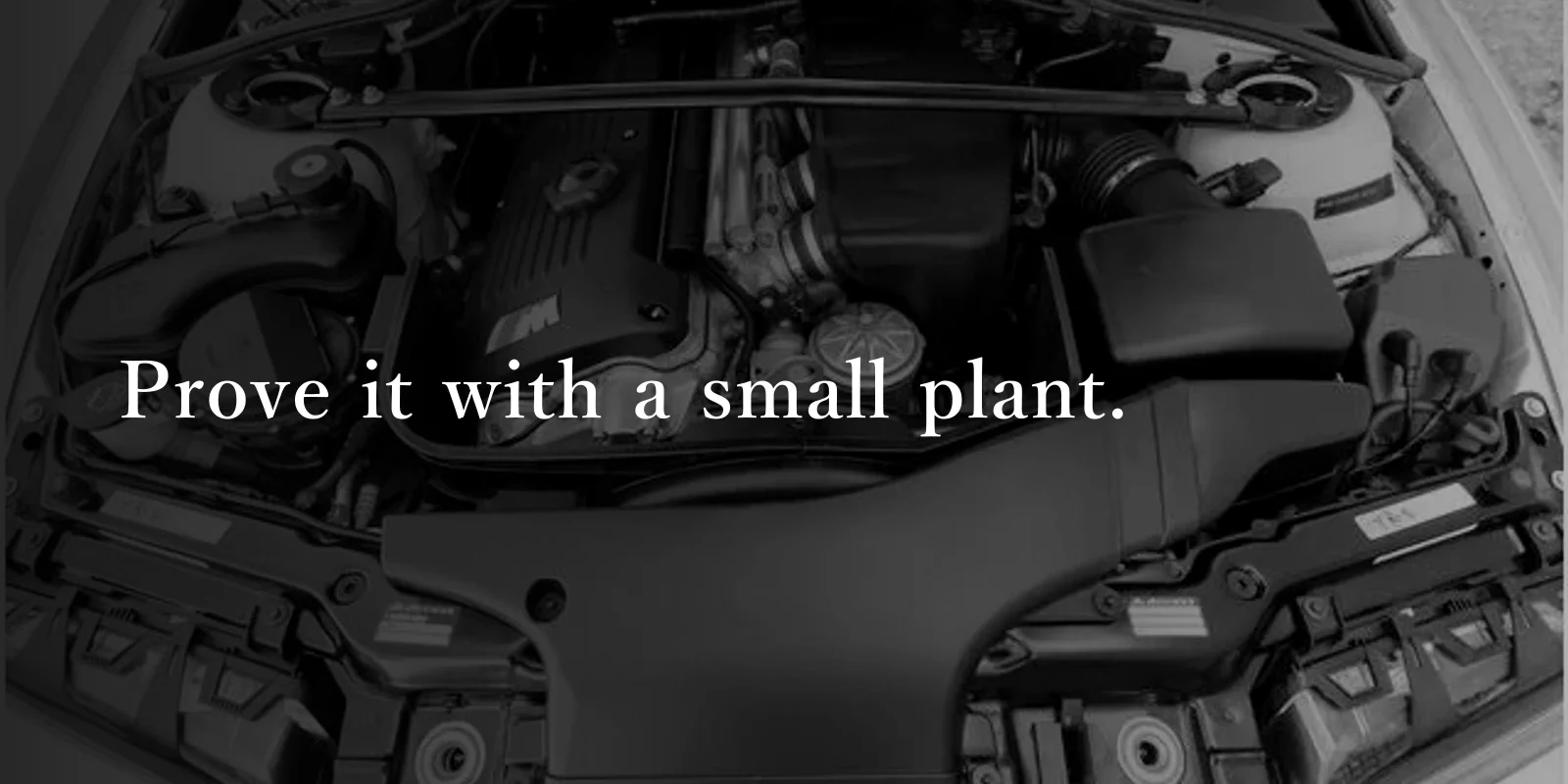
In this post, I'm writing in detail about why I keep developing tools for the BMW E46 M3 as TSUNAGI///M, where my motivation to keep going comes from, and what I'm aiming for.
Why now? Because I've reached a turning point for moving on to my next step, and I felt I needed to clearly separate the role of my past self from the role of my next self.
I've come to see clearly that if I cling to the me I've been until now, I can't move on.
This article is for turning who I am now into a stepping stone to what comes next. And I'm writing it down as my wish that anyone who reaches a stage of growth like mine will go down that road with confidence.
What I wanted to prove
I started out as a maintenance engineer at a waste incineration plant.
After that, in the same company, I planned and developed a system for managing maintenance history, and explored a new business built on that system.
For various reasons, the new business was stopped before it ever saw the light of day. I didn't want it stopped, so, looking for a place where I could carry on with it, I became an implementation consultant for an equipment maintenance management system (IBM Maximo).
I left that second company after 3 years; in all, I built up 13 years of experience in the equipment maintenance industry.
That's 5 years in the field and 8 years implementing equipment maintenance systems.
In the 5 years since I went out on my own, too, one way or another I've stayed involved in maintenance. By maintenance I mean things like car maintenance, developing a new service that makes use of history data, and helping with Maximo data migrations.
But for those 5 years on my own, both the number of services I delivered and my income stayed low.
Back when I was an employee, by contrast, the company I was with for those 3 years gave me plenty of satisfaction with my income and with its brand.
I was so satisfied it surprised even me, and I felt blissful every day. (If anything, I was so fulfilled that my drive dropped a little.)
Even so, I had a strong urge to prove something, strong enough to throw all that away. But what I was proving, and to whom, and what I wanted to become, I couldn't put into words until recently.
What I found after going out on my own, by reflecting and talking with people over and over, is this: I wanted to experience seeing through to the end what I'd decided to do myself, and to prove to myself that I have it in me.
It starts in childhood
As a kid, I dropped everything halfway, gave up, blamed others when things didn't go well, got scolded, and stopped caring because none of my wishes ever came true.
But I didn't have the nerve to go off the rails, either, and I came to find myself pathetic, only ever thinking things in my head and never acting on them.
Still, the reality was that my family wasn't well off, so there were a lot of limits, and compared with the people around me I used to think how unfair it was.
I could see it vividly: if I let myself rot like this, I'd end up regretting it, wondering what my life had been for.
I've only got one life. I want to die able to be proud that I was a cool guy.
To get there, the only way was to take on challenges, starting now. Take them on every day. I made up my mind to make that my default (my comfort zone).
Age 27, Isezakichojamachi: a realization at 1 a.m.
Let me tell you a story from the past. It was when I was running the company's internal DX (digital transformation) and a new business side by side at the plant engineering company I worked for.
With nothing moving forward and the people around me pushing back hard, I was crushed by my own worthlessness and incompetence, and there was a time I thought about dying.
What I realized at 1:00 a.m. on the second floor of a café in Isezakichojamachi, Yokohama, was that if I died right now, neither the company nor society would change at all; everything would just carry on as usual.
Whether the DX succeeded or not, whether the new business took off or not, nobody would be in trouble, and things would turn out however they turned out. That's what I felt.
After that, all the precious-sounding ideas and messages running rampant in the world, and the company presidents and consultants who seem so dignified, suddenly looked like clowns, and I started to feel it was all entertainment, staging worthless things to look valuable.
TV commercials, which I'd always found fishy, felt even fishier. Social media started to look like the laments of puppets forced to perform by a tiny handful of entertainment directors (presidents and consultants), and the information pouring out nonstop made my head spin.
To get away from that sick feeling, I started shutting out information, and at the same time I realized: "the only way to live happily is to enjoy what I do myself, and to have confidence."
I think it was the winter I was 27...
The real-life Game of Life
That's where it started: the change in how I see society.
Or rather, I came to think of it as just a real-life Game of Life (the board game).
Even the system planning for the DX push I'd been staking my life on became a board in the Game of Life.
When a proposal didn't go through or a budget got cut, it stung just like losing a Mario Kart race against a friend.
As kids we cried with frustration, right? As an adult I cried with frustration just the same.
A game is fun as a game because there are rules, walls, and other players getting in your way.
The moment you cheat, it stops being fun, or rather, it turns ridiculous.
In junior high, I collected 251 Pokémon in Pokémon Gold and Silver on my own.
After that, in Ruby or was it Sapphire... I used a cheat tool called Pro Action Replay to max out the Pokédex the easy way.
I was stunned by the difference in how I felt. Nothing stayed with me. Nothing but emptiness.
After that, I never used a cheat tool again.
Work alone was boring, so when I thought about playing another board game alongside it, the world of cars came to mind. (It's interesting to dig into, but I'll skip it here. I think I once wrote about how it came about on the blog, but I may have deleted it.)
At the time, I lined up every car in the world side by side and thought about which one I wanted most, from points of view like culture, technology, ease of upkeep, how satisfying it is to drive, and the people I'd likely meet through it, and I bought a HONDA S2000.
The one I agonized over right to the end was the BMW E46M3. (Today I drive an E46 M3.)
When the DX and the new business weren't moving the way I wanted, I did think about quitting the company, but I could do what I wanted and buy what I wanted, and I felt I was in a frighteningly happy situation, so I stopped seeing any point in quitting.
The limits of self-sacrifice
The turning point came late in the year I was 28.
Until then, I hadn't given one thought to getting married or raising kids.
I had fun work, drove around in a car I loved, went to sex clubs, and kept satisfying myself, but there came a moment when that me suddenly felt ridiculous.
I'll never forget it: in a Leopalace (a furnished rental apartment) in Komaki, where I was on a business trip, masturbating twice a day, I was intensely aware of death.
"Isn't the meaning of human life in raising children?" Once that welled up from deep in my head, I ran 5 dating apps at the same time, got fooled by fake profiles, got into fights with people I matched with, and after all that, a year later I found my wife and married her. Half a year later, our eldest daughter was born.
But I didn't notice that, along the way, something in me had gotten warped.
When I started on the dating apps, nothing worked at all for about 9 months. I put around 450,000 yen into them and got nowhere. (Looking back, I almost think I'd have done better with an old-fashioned matchmaking service.)
I figured the cause was probably that I couldn't get out of my old way of thinking, filling my own needs on my own, and a deep-down "I just want my own needs met" was seeping through.
So I switched my mindset: erase myself, resolve to give everything to a wife and kids, and show it.
After that, I started getting matches, and along the way I met my wife and went on to marry her.
It went smoothly, one step after another.
I can say it now: that spirit of self-sacrifice, erasing myself, was no good.
Recently, in chapter 1196 of the manga One Piece, there was a scene where Sanji, fighting Saint Killingham, struggles after Iva-chan (Emporio Ivankov) points out the weakness that keeps him from fully awakening his Conqueror's Haki: not enough self-love.
I related to that scene a lot.
I had realized that, when it comes to protecting my family's freedom, the self-sacrifice approach has its limits.
For example, if I died in an accident now, the mortgage would be cleared and the survivors' pension would come in, so they'd have what they need for a bare-minimum life.
But then, if the kids said they wanted to win at figure skating to prove themselves, or win at horse riding, or master canoeing, or build a business everyone can enjoy and have fun with it, without me they'd lose the chance to go for it at the moment they need it. (Though I think part of it depends on them.)
So I thought everyone would feel happier if I stay healthy, earn from a business that fires me up, and invest in the kids with that income and the time it frees up. And I'd be satisfied too.
What's more, I thought kids like that could influence other kids and teachers through school, lessons and so on, and pass happiness along in a chain.
The difference between Sanji and me is that Sanji is in a situation where the people around him tell him to stop sacrificing himself, while I felt pressure from the people around me to sacrifice myself.
I think these sound close but are completely different stories. Still, I was feeling the limits of who I was then.
My struggle comes from the urge to break through those limits.
But my problem was that I blamed my not breaking through on my wife and kids getting in the way.
With that mindset, I'll never break through my limits.
Facing the same way as my wife (the CEO of our household)
The bar for having proven what I set out to prove is "until I'm satisfied," which is extremely vague. It's almost an aesthetic.
"You'd expose your family to instability for your own self-fulfillment?" Anyone with common sense would say that, all in one voice.
My wife did too, at first.
But after talking it through with my wife again and again, and talking with the people around us about how to live, the conclusion we reached was: "Let's both live with no regrets."
With my income staying low, my wife has told me over and over to get a part-time job, and called me a liar and a fraud for blowing way past my own deadline for bringing in revenue. Even so, she lets me stay true to my aesthetic.
Back then we were living on spending that only worked with two incomes, but my wife, wanting to live her own way too, quit her job, and we cut our standard of living to less than half.
I didn't have one bit of complaint about that. If she wanted to, she should, and I welcomed it.
After all, I was going to choose that way of living too, later on, and I thought it would be unfair if I got complained at for it.
Our income dropped sharply, but thanks to the time we gained, I got to do everything I'd only ever thought about wanting to do, and I was thrilled at how good that felt.
Of course I feel anxious watching our savings shrink, and frustrated and anxious that neither the development nor the revenue is growing the way I'd hoped.
All of that included, I can feel that I'm alive, and for the first time I learned: so this is what they call happiness.
The big failure of "TSUNAGI"
At first, I thought what I wanted to prove was "making an equipment maintenance system succeed as a service."
Reflecting on it, I'd have to say I was "looking at the tool (the means), not the essence."
Without a company's brand behind me, I didn't think I could put out a competing product in the same industry.
So I went in the direction of making a maintenance-history service succeed for the car maintenance industry.
But it was a big failure.
I built it with the no-code tool Glide and released it under the name "TSUNAGI" (the service that came before TSUNAGI///M), and after 5 years it had about 50 registered users. A crushing defeat.
Why it failed, I didn't really understand until very recently, or rather, I still don't.
On the surface, experts would say I did no marketing at all, or that my business model design and UX were half-baked.
The root of it is a mental block: why couldn't I do those things? Or why didn't I do them, even knowing they were needed?
Say this, and the bosses of the Showa era (1926–1989) would say I lack guts, or lack resolve.
I'd like to ask bosses like that: why were you able, back then, to find that kind of guts and resolve?
Probably because back then, doing it was seriously the only way to survive, or they had fierce urges, like wanting to wear the symbols of financial success, or wanting to prove somebody wrong.
I had a period like that too, long ago, but I have none of that now.
And that brings me back to what I actually want to do.
Changing the direction of the flow, just a little
Back to when I started shutting out information: when I was confused by all the information, Google's mission at the time was "to organize the world's information and make it universally accessible and useful."
What I hoped for from Google was a world where it would trample the sites so buried in ads you can't see the information, and the thin product-comparison sites with nothing in them, and where deep technical columns that ordinary people find hard to understand would be laid out clearly and cleanly and reach the people who need them, seamlessly.
But I can't shake the feeling that Google today is somehow different.
I understand that when you take huge investment from investors, meeting their expectations sometimes means bending how you think. But it disappointed me that the Japanese sense of beauty, cherishing your founding business and polishing it with no regard for profit, never took hold in an American company.
That said, I'm not going to sit on my hands and wait. I'll do what I can. That's how I think.
It's a very small thing, but I organize technical information on maintaining and tuning the E46M3 and get it, through this site, to the people who need it.
In the same way, for the things in my life that have felt wrong or bothered me, I have a concrete picture of how to change them, how the people on the receiving end would feel, and how they could grow.
At TSUNAGI///M, I keep running proof-of-concept research on building a foundation that can resolve the problems in society I've felt, using the E46M3, a subject within one person's reach.
So what I do as TSUNAGI///M is my way of living itself, and the seed of the change I can bring to society.
I'm not so presumptuous as to think I'll change the world by myself.
Happiness spreads to the people who come into contact with TSUNAGI///M, the influence carries on to the people close to them, and as it spreads, one day it all changes with a bang. That's the strategy I'm taking.
I proved it with a small plant
"Start small, and keep at it."
Today, big, high-impact things grab people's attention, and many people may aim for those.
There's also the way of Bill Gates or Masayoshi Son (of SoftBank): buying up things that already exist, combining them, putting them into distribution, and getting big success all at once. But in the end luck plays a big part, and I think the essence, what's behind a big success in a short time, is having steadily piled up small things (trust, negotiating power, knowledge, ways of thinking and so on) to catch that luck.
Back to my story: I still remember a senior colleague at the plant engineering company chewing me out.
"You can't even maintain a small plant properly, and what's this 'let me do a big plant'?"
Back then, the plant I'd been given as a new graduate was an offshoot the company had built, a special type, not the standard model.
There were no manuals or drawings, no history, no part numbers for ordering, and I was at a loss: what was a newbie who knew nothing supposed to do with this?
Unluckily, the company had a culture of "the small plants go to the people who can't do the job; the bigger the plant, the more it goes to the aces," and I, doing both the in-house DX and maintenance engineering, really hated being seen by the people around me as someone who couldn't do the job. (Now I think it was a petty pride.)
So when I asked my boss to let me do a big plant, what I meant was: at least let me take a standard-type plant whose documents still exist and whose technology the people around me know well. But I think my oddly overconfident, proud attitude warped what I said and how he took it.
So I gritted my teeth about how others saw me, and on that small plant I delivered results that beat the profit margin of the biggest plant.
I put the documentation fully in order, and set up a system so the next person could make a profit the same way.
And at the plants I took on after that, I reproduced the same system and contributed to the company.
Inside the company I never heard a word about how I was rated, but clients and partner contractors told me things like "We don't want you taken off this" and "You've shot straight to No. 1."
One day, I happened to be talking with someone near the desk of the head of the sales division, and I overheard him muttering to himself as he looked at his PC screen: "This one plant's margin is insane. Who's running it?"
Hearing that, I soaked in self-satisfaction.
Treating the E46 M3 as a "plant"
And now, treating the E46M3 as a "plant," I'm building, as TSUNAGI///M, the system I built back then and the system I wanted to build beyond it.
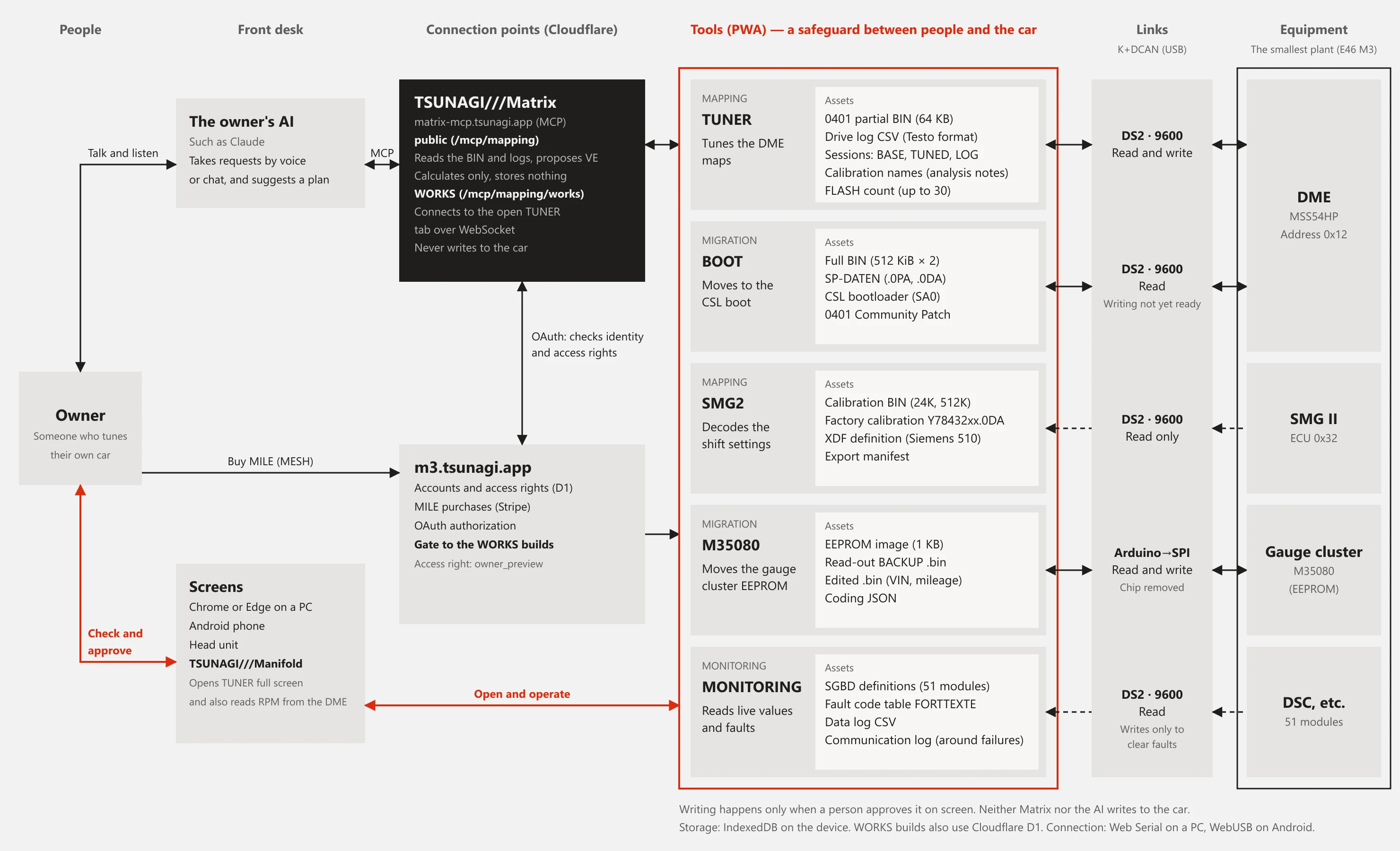
It's a system that not only I but my predecessors in maintenance have dreamed of for more than 40 years.
The figure above shows it with the E46M3. What if we drew the same figure for a plant?
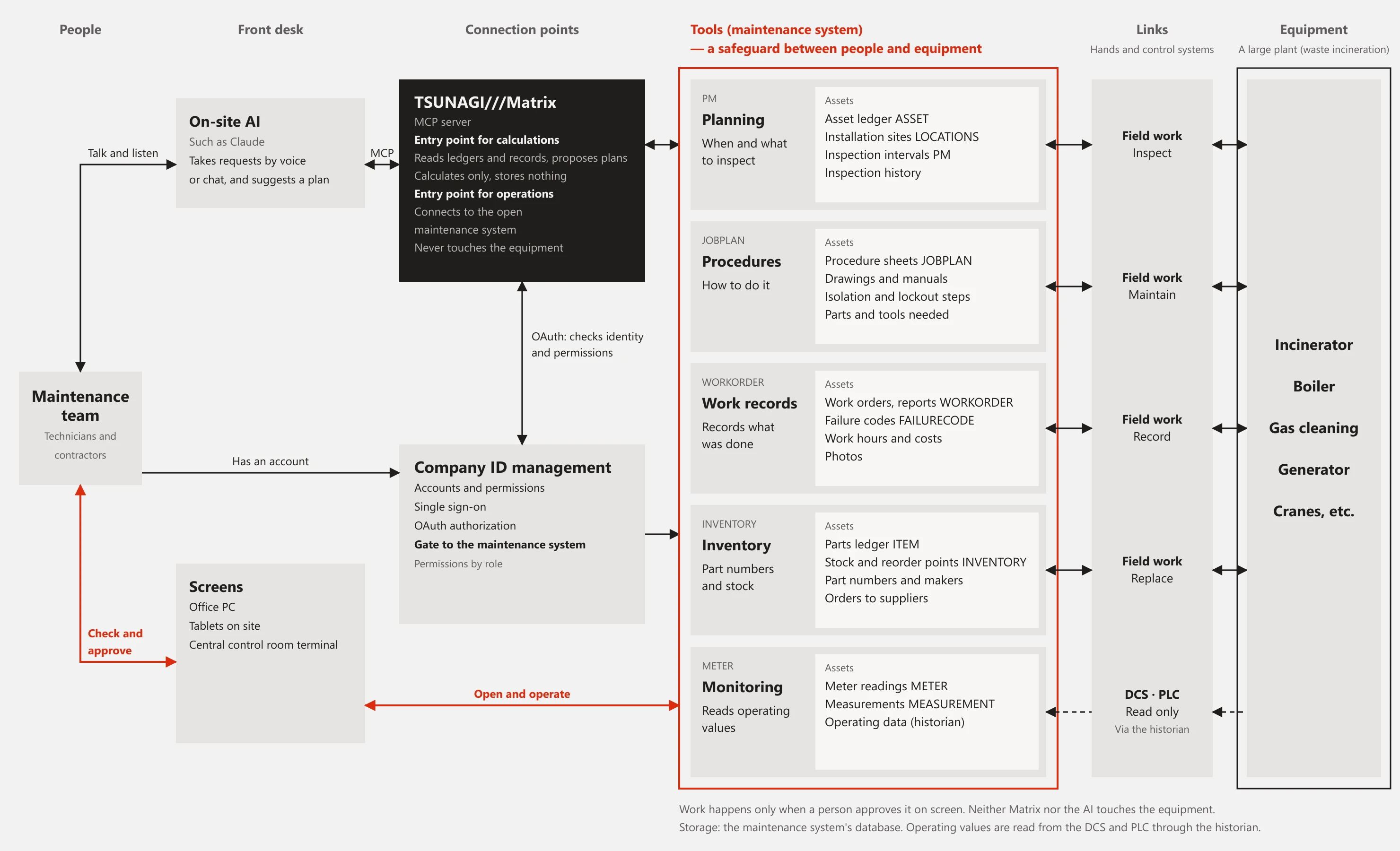
Doesn't it give you the impression it could be done easily?
Of course, the bigger the scale, the more you have to consider: the detailed component technologies, legal requirements, performance and so on.
But the fact that the "system" runs and gets results doesn't change, so all you have to do is work out the details toward that.
Of course, working out those pieces can't be done alone, so it is hard. And whenever I talk about this with people inside a company, there's always someone who desperately lines up "the reasons it can't be done."
That probably comes from a fear that their own position will be at risk.
I think people like that probably have something sharp in them, so it may be good to let them "recharge" once and give them time until they act on their own.
The business model after the system goes in
So what happens to a company that brings this system in?
Does it look like people won't be needed?
A plant operation run by 20 to 30 people might run with 10 to 15.
Management may think costs will be freed up and they can raise the profit margin.
Is that way of thinking really right?
The people in the field can easily imagine the fear: bring in a system like this, headcount drops, and they get let go.
So they become uncooperative about bringing it in, and refuse it.
Haven't managers up to now just stopped there, with "it can't be helped" and "we have no ideas"?
How about changing the way you think?
No layoffs, no pay cuts (a small raise, in fact), and if the work is done and there's time left over, how about letting people use that time however they like?
What do you think happens then?
People can't stand being idle, so they try to create some kind of work.
People with families might go home and take care of things at home.
People who feel they have no place at home might stay at work and start, little by little, on something they've wanted to try.
Couldn't those small things they start become the seeds of a new business?
Wouldn't being able to go home for personal reasons give a socially clean image, and raise the company's value?
On the cost side, the maintenance you thought was necessary may actually have been excessive, done so the field could avoid responsibility, or may have cost more because vague procedures had contractors pricing in a safety margin.
Cut that excess, and maintenance costs should drop a lot without cutting people.
Just because maintenance costs went down, do you need to lower the price of what the plant produces right away?
Customers see value at today's price and buy. Lower the price, and they'll wonder what it was all for until now, and their satisfaction actually drops.
Partner contractors may see their sales drop a little. But with the work clearly defined, costs are easier to control and profit easier to make.
So making room to breathe is a win-win.
On top of that, aren't you filling that room with work that isn't needed, so as not to lose out?
I call this a poverty mindset. When management's poverty mindset packs the work too tight, it crushes people's room to breathe, mistakes go up, and covering for them ends up costing more money and time, not less.
Everything I've said so far is what I actually researched and proved in plant maintenance, and was able to reproduce as the same system at several plants.
TSUNAGI///Methodology
TSUNAGI///Methodology is this system made reproducible, with technology adding more potential to generate profit on top.
What it says is something you often see in talks and consulting proposals on using AI and IoT in manufacturing.
But I've rarely heard of a case where it was actually made real.
So, to prove clearly to more of you that this can be made real, I've been developing it like this, with the E46M3 as the subject.
It's exactly what my senior colleague told me back then: "You can't even make it work properly on a small plant, and what's this 'make it work on a big plant'?"
On the E46M3, I've made the system almost entirely real.
At plants, too, the components are already real.
It'd be a waste to leave this system asleep.
But next, I also want to take on the business of making fuel from waste.
Thinking about how to do both, I've packaged this system as Skills for AI agents, plus advisory services, so I can hand it to you and you can run it on your own.
That's Mainstay, one of the tiers of MESH.